
"The Uprising:" A Film Caught Between Fact and Fiction
Lets face it - 2026 has not been a good year in America. With mounting economic and geopolitical pressure, a decade old culture war that refuses to die, and the rotting of minds both young and old by that most ubiquitous of demons: Generative AI, one could be forgiven for indulging in daydreams of revolution. Our country was founded by a revolution after all, why shouldn’t we dream of wiping the slate clean and starting again? Some days it seems as though the entire world screams through our phone screens, angrily yelling “Rise up already!” As we scarf down fast food and celebrity gossip chased by sugary alcohol and vaporized nicotine. But revolution is a bloody, complicated affair, not to be taken with the ease of the “post” button on one’s social media platform of choice. With that in mind, English filmmaker Paul Greengrass saw that now was the time to create The Uprising, serving on one hand as a rallying call to all the tiny people who have been deluded into thinking that popular revolution is just a pipe dream, and on the other, a dreadful reminder that the only constants in life have not changed: it’s death and taxes all the way down.
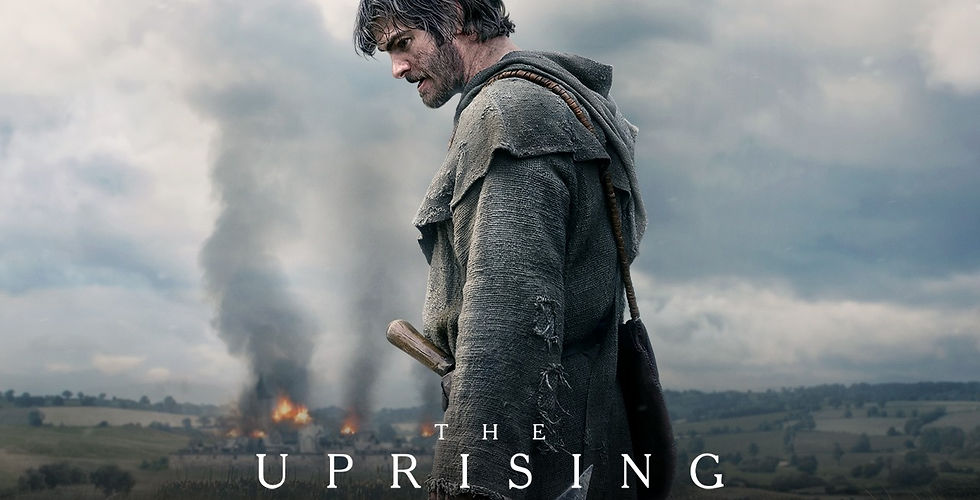
Though it started life as The Hood, an origin story of mythic outlaw Robin Hood, The Uprising sells itself as a gritty historical drama about the 1381 English Peasant’s Revolt, an insurrection stemming from the intense economic inequality that followed the Black Death. Starring Cosmo Jarvis and Jamie Bell as the uprising’s leaders, Wat Tyler and John Ball respectively. The film does an excellent job of staying faithful to the historical narrative… until it doesn’t. As the film’s origins may suggest, the main star of this story is not either of the historical leaders of the rebellion, but Andrew Garfield, cast in the role of a laborer simply known by the title of his occupation: Ploughman. Though Garfield’s Ploughman masquerades as a convenient audience surrogate, the ugly truth of his role was cemented by the film’s own marketing, as the tagline “The Rise of Robin Hood” was slapped onto the film just weeks before release. To the skeptical viewer, this raises one vital question: Can Greengrass successfully blend the mythic rise of a cultural icon with the real events that inspired his story? Or will Greengrass’ head end up on a stick, carried along by a angry mob of history buffs?
Though it would be easy to write The Uprising off as a film that does not know what it wants to be, I wish to give credit where credit is due. There was some truly remarkable attention to historical detail in the crafting of this film. Jarvis and Bell are excellently cast as Tyler and Ball, with Bell’s accent work especially ringing incredibly true to what we know of the time period. The film follows a chronology that anyone who knows the story of the peasant’s revolt (or has listened to Roy Bailey’s Song of The Leaders) should find easy to follow. Once the people of Kent, Essex, Surrey, Middlesex, Norfolk, Suffolk, and Hartfordshire gather together under the Heretic Priest of Colchester, it’s a straight shot to the sack of Canterbury, Corpus Christi in London, and that fateful day in Smithfield. As an unrepentant history nerd myself, I was quite pleased for the first half of this film. However, once the rebellion reaches London, the film’s issues begin to make themselves abundantly clear.

Garfield’s Ploughman, though he is never referred to as such, is highly implied to be the nascent Robin Hood. Starting our story as a naive peasant rebel that, although he has suffered greatly, ardently believes that the divine authority of the Crown will deliver England from the evils of a nobility steeped in greed. Despite his starring role and the absolute berth of development time in comparison to much of the film’s other characters, The Ploughman struggles to escape his dual lineage as the future mythic hero, and the humble audience stand in. While it is an admirable message that anyone can rise to be a hero, and even with all of the time dedicated to espousing the humility of his origins, Garfield’s character never feels like “just anyone”. The Ploughman’s actions directly lead to the start of the uprising and the majority of the other characters in the film are loathe to let you forget it. After he has a chance meeting with the Queen Mother (Katherine Waterston), Garfield’s Ploughman begins to feel more like a piece of historical fan fiction than his own character, taking the role of the epic action hero who gets to do all of the cool things attributed to nameless peasants throughout the historical narrative.
Alongside The Ploughman for much of the film is Alyce, a former nun turned revolutionary played by Thomasin McKenzie. Though Alyce’s backstory serves to further elucidate the societal ills that preempted the eponymous uprising, her dynamic with The Ploughman brings very little in the way of pathos to the screen. The sad truth is that Alyce’s role is so small that she could have been removed from the plot without too much actually changing. Though she was likely meant to represent the women who rose alongside their brothers, husbands, fathers, and sons during the uprising, her absolute lack of consequence on the story and the total underutilization of Mckenzie’s talents do little to highlight the historical importance of women in revolutionary movements. Unfortunately, Alyce’s chaste will they/won’t they romance with Ploughman is not particularly interesting when it has to share space with all the other stuff that happens in between each round of (literally) dirty peasants hacking rich men and knights to pieces with farm tools.
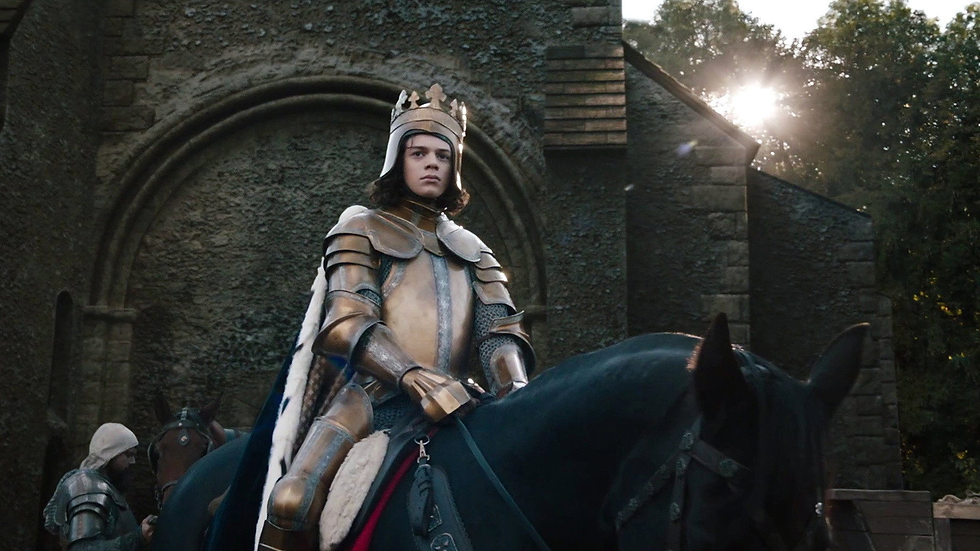
While The Uprising does occasionally succeed at creating moments of cinematic beauty, I find that the film is held back by what some online call out as “stereotypical medieval color grading”. The phenomenon of drab palates and desaturated colors is not unique to the medieval subgenre, but it has been an almost ubiquitous signifier of the so-called “Dark Ages” which, while containing plenty of human misery, societal stagnation, and collapse, wasn’t quite as “Dark” as popular culture makes it out to be. Many of the nobility in this film wear ornate and immaculately colored outfits, and while there are moments where their brilliance shines through, the colors ultimately are muddled by the “mud brown” filter that characterizes the genre. The film’s cinematography is another point of pain, as while there are plenty of picturesque shots littered throughout, they are more often than not jarringly intercut with shakycam footage. This took me entirely out of the film each time it occurred, and while it somewhat abated by the film’s climax, it was replaced by a gratuitous slow-mo slaughter scene that I couldn’t help but groan at.
Ultimately, while there is a halfway decent movie about Wat Tyler and John Ball’s uprising somewhere deep in this film, the need to tie it to Robin Hood totally wrecks any real potential it may have had. Fans of Robin Hood will not be pleased by how little this film is really about Robin Hood. Fans of the 1381 Peasant’s Revolt will not be pleased by how much of this film is a decently faithful retelling of the historical account, only to be upended in the last half hour by the origin story of Robin Hood. For a film about a popular uprising, I find it truly ironic how little popular appeal The Uprising has. That being said, as a huge history nerd, the chance that I will be revisiting this film at some point is fairly high. Will I be skipping scenes? Yes. Will I be turning the film off with 20 or so minutes left? Absolutely. But I will be forever grateful to everyone who helped this film get made. Even though only a portion of this film does justice to the history in the way that it deserves, that portion makes everything else worth it in my eyes.


