Emerald Fennell's "Wuthering Heights" Bastardizes a Classic

Updated: Feb 15
This Valentine's Day weekend, audiences finally saw the arrival of one of 2026's most highly anticipated films: Emerald Fennell's Wuthering Heights, starring Margot Robbie and Jacob Elordi. Based on the 1847 novel by Emily Brontë, this beloved classic is no stranger to being adapted for the screen. Whether it be for a feature film or a mini-series, Wuthering Heights has been retold countless times, as far back as 1939. This tale of forbidden love and class disparity in 18th century England is one that audiences simply cannot get enough of. This latest adaptation by British director, Emerald Fennell is perhaps the most ambitious version yet, one that is not afraid to drift away from the source material. But how far can you go and still accurately call this story Wuthering Heights?
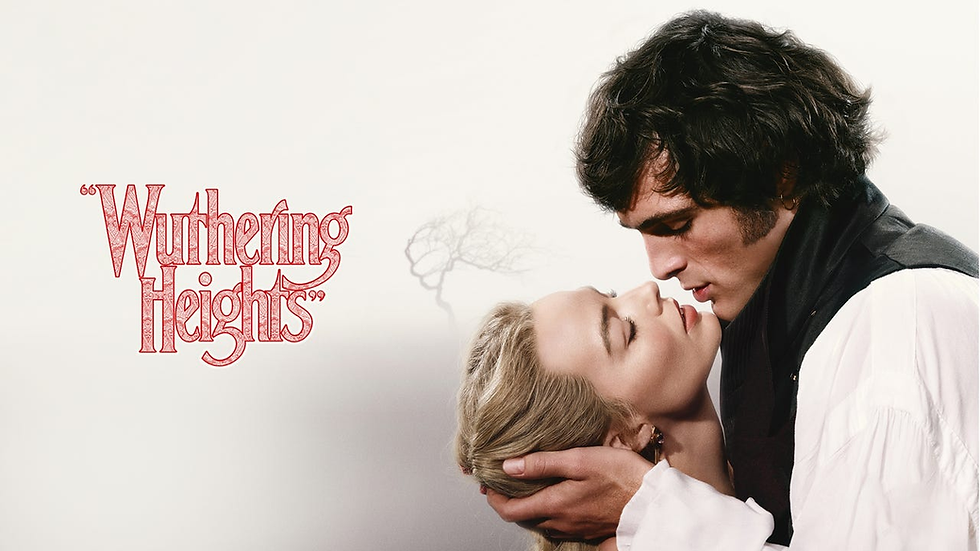
Emily Brontë's Wuthering Heights is one of the most beloved works of the Victorian period. For nearly two centuries it has been adored for its unorthodox storytelling, complex characters, raw emotion, and poignant commentary on class disparity. Its two main characters, Catherine and Heathcliff are some of literature's most enduring protagonists, so fans of all ages were ecstatic to see them come to life on screen.
"Wuthering Heights" is the third feature film by Emerald Fennell and her longtime producers, Tom Ackerley and Margot Robbie, who also stars as Catherine. Due to its high production value and sheer ambition, the project has been in development for a long time, only prolonging the excitement of fans everywhere. It's important to note that this film's title has intentional quotation marks, something that I can only assume means that this is merely the director's take on the classic instead of a straightforward retelling.
I respect the hell out of Emerald Fennell and company for taking so many creative risks with "Wuthering Heights." It's clear that a lot of passion and effort went into every frame. The budget was around $80 million but frankly, it looks like it was a lot more. But while the film is a visual marvel, it is far from flawless.
Emerald Fennell's "Wuthering Heights" has a unique curse in that every one of its strengths also ends up going against it. For example, the production design, costumes, cinematography, and general visuals of this film are all incredibly well done, a feast for the senses, but they all feel garishly out of place. This is especially true for the original soundtrack by none other than electronic pop star, Charli xcx, a choice that still leaves me shaking my head, even as a fan of her music.
Legendary costume designer, Jacqueline Durran's work in this film ranges from absolutely breathtaking to downright baffling. After all, this is a period piece set in Victorian England and the main character is wearing dresses that looks like they're made of saran wrap. The sets are colorful, dynamic, and gorgeous, but again, why does a Victorian mansion have a room with glittery walls? I can admire just how highly stylized this film is, but this is classic style-over-substance filmmaking. As an audience member, I would rather the sets and costumes look drab and boring if they helped tell a story accurately. Intention is very important to a film's mise-en-scène and it feels like the art department behind "Wuthering Heights" was simply more concerned with what would look cool rather than what would enhance the story.
I can appreciate the wide, ambitious swings that the cast and crew attempted with this film, but far more of them ended up being misses than hits.

But the visual aspects of "Wuthering Heights" aren't the only thing that remains unfaithful to the source material. Prominent story features have either been drastically changed or cut out entirely. Most notably Catherine's missing brother, Hindley, and the ending being completely rewritten. It is commonplace for a classic to be somewhat reimagined or changed when being adapted for the big screen, but this simply isn't Wuthering Heights anymore. It can only be assumed that Fennell and company mutilated this story to make room for the excessive amount of violent sex scenes. After all, sex sells, especially when the ones doing it are some of the most attractive actors in Hollywood.
I can't help but feel like Emerald Fennell wrote her own script with vague similarity's to Emily Brontë's novel and just slapped the name Wuthering Heights on it. The whole thing feels incredibly...disrespectful. Yes, the property is public domain but that doesn't mean you can just do whatever you want with it. Emily Brontë's writing choices were intentional. The scenes, character dynamics, and themes in her novel were all written to tell a coherent story of class difference and forbidden love, not a smutty booktok fantasy. Simply put, Emerald Fennell's "Wuthering Heights" entirely misses the point of the original story. Despite being two hours long, it is a drag to sit through and ends up feeling like twice the length.
In addition to the glaring story issues, the casting feels just as out-of-place as the visuals. Margot Robbie, while a great actress and producer, unfortunately has what the internet has come to deem "iphone face," when an actor's features are simply too modern to fit comfortably into a period piece. But by far the most controversial casting choice was Jacob Elordi as Healthcliff which will not be obvious to anyone who has not read the book. In the novel, Heathcliff is described as having dark skin, dark hair, and dark eyes. While his ethnicity is never explicitly stated, he is often theorized to be of South Asian, African, or most likely Romani descent. This was again, an intentional character choice of Brontë to emphasize Heathcliff's social differences when compared to rich, white Catherine. While Elordi gives a decent acting performance, being hot is simply not enough to bring Heathcliff to life, authentically. Other non-white actors like Hong Chau and Shazad Latif were cast to play historically white characters in the film, so why not cast a non-white actor in the role where it really matters?

This film could've been decent, if it was not titled "Wuthering Heights." I went in expecting a smart, carefully crafted period piece about race, wealth, and social class and instead was bombarded with a bunch of iphone-faced Australians having rough sex for two hours set to Charli xcx music. Emily Brontë is no doubt, rolling in her grave as we speak.